Print-on-Demand Costs: What Products Cost in 2026
Updated First published 45 min readYuma Heymans
The practical guide to what every print-on-demand product actually costs to make, and how to turn that cost into profit in 2026.
A 3x3 inch kiss-cut sticker costs about $1.58 to make. That same sticker costs $6.17 to actually ship to your first customer. That single gap, between the price a supplier quotes you and the price you really pay to fulfill one order, is where most print-on-demand sellers quietly lose their margin. It is also the number almost no supplier puts in front of you before you build a store around their catalog.
Print-on-demand looks simple from the outside: upload a design, a supplier prints it on a blank, and the product ships to your buyer while you keep the difference. The economics underneath are anything but simple. The base cost you see on a product page is only the beginning. Add first-item shipping, subtract the marketplace fee your channel takes, and the comfortable margin you imagined can collapse to a few dollars, or to nothing. Getting this right is the difference between a store that compounds and a store that runs a busy loss.
This guide breaks down exactly what print-on-demand costs in 2026, using real, cited base costs and landed costs for every major product, from a $1.58 sticker to a $37.57 all-over-print backpack. It explains the three numbers that matter (base cost, landed cost, and margin), walks the entire catalog product by product, maps the supplier landscape after the industry's biggest merger, breaks cost down by print method, and gives you a decision framework for pricing that actually holds up when the fees come out. Every figure here links to the source that proves it, because a cost you cannot verify is a cost you cannot trust.
Contents
- What print-on-demand actually costs: the three numbers
- Base cost: the blank plus one print
- Landed cost: why shipping is the number that matters
- What every product type costs to make in 2026
- The supplier map: why the same product costs different amounts
- Print method and its cost
- From cost to profit: the margin math
- Where sellers lose money on cost
- How to choose: a decision framework
- The future: price transparency, live data, and AI matching
1. What print-on-demand actually costs: the three numbers
Print-on-demand is now a large and fast-growing market, which is exactly why cost discipline matters more than it used to. The global print-on-demand market was valued at $12.96 billion in 2025 and is projected to reach $118.85 billion by 2035, a compound annual growth rate of 24.81% - Precedence Research. The United States alone accounted for $3.23 billion in 2025 and is forecast to hit $31.16 billion by 2035 - Precedence Research. A rising tide like that pulls in a flood of new sellers, and more sellers competing on the same blanks means the winner is usually whoever understands their true cost the best, not whoever has the prettiest design.
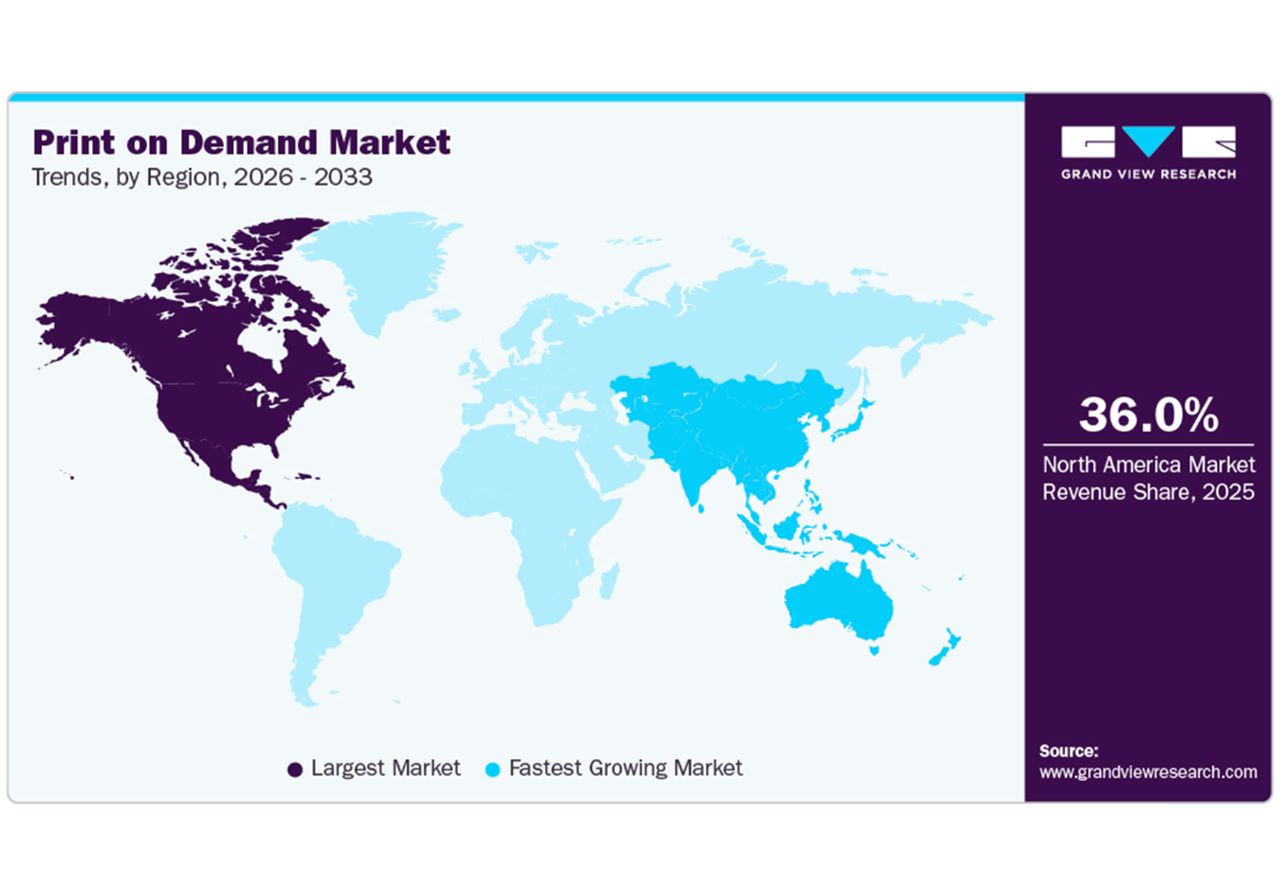
North America is the center of gravity for this market, which is why most published base costs and shipping rates are quoted in US dollars and US shipping zones. North America holds roughly 36% of the global print-on-demand market share - Printful, citing Grand View Research. That regional concentration is worth internalizing before you price anything: the "standard" costs you will see, including the ones on the full cost board on this site, assume US production and US first-item shipping unless stated otherwise, and your economics shift the moment you sell into another region.
The competition you are pricing against is enormous, which is the real reason cost discipline is not optional. Over 368,000 Shopify stores use at least one print-on-demand app, out of roughly 2.85 million active Shopify stores, and about 228,000 dedicated POD stores operate worldwide - Printful. On the marketplace side, Etsy counted about 5.7 million active sellers in the twelve months to June 30, 2026 - Etsy, and a large share of them sell the personalized and customized products that the POD model produces. What that scale means in practice is that for any popular design idea, dozens or hundreds of sellers are printing the same blank through the same handful of suppliers, so the buyer's choice often comes down to price, and the seller with the lower true cost can either undercut the field or simply keep more of every sale. In a market this crowded, cost is not a back-office detail; it is the competitive position.
Every real print-on-demand decision comes down to three numbers, and confusing them is the single most expensive mistake a new seller makes. The first is the base cost: what the supplier charges to make one item, the blank plus one print, before anything ships. The second is the landed cost: the base cost plus first-item shipping, which is the actual amount that leaves your account to fulfill one order. The third is your margin: your sell price minus the landed cost, minus whatever fee your sales channel takes. Only the third number is money you keep.
The reason this ordering matters is that suppliers advertise the first number and you live on the third. A product page that reads "from $10.69" is telling you the base cost, the most flattering figure in the stack. The seller who reads that as their cost, prices at $19.99, and expects the whole difference as profit is in for a surprise once first-item shipping ($4.99 on that tee) and an Etsy or Shopify fee come out. Understanding all three numbers, in order, is the entire game. The rest of this guide is a tour through each one with real, current figures attached.
For orientation, here is the practical hierarchy the rest of the guide follows: the base cost is what the supplier states, the landed cost is what you pay, and the margin is what you keep. You can inspect all three for any product on its own page, for example the Unisex Staple T-Shirt or the 11oz Ceramic Mug, where the cheapest supplier, the landed cost, and a live margin calculator sit side by side. Keep that hierarchy in mind, because every supplier marketing page is built to keep your attention on the friendliest of the three.
2. Base cost: the blank plus one print
The base cost is the foundation of every print-on-demand price, and it varies more than most beginners expect. Across the products tracked on this site, a postcard costs $1.53 to make at Printful and a 3x3 inch kiss-cut sticker $1.58 at its cheapest supplier, while an all-over-print backpack costs $37.57 and a twin-size all-over-print comforter $78.59 at theirs - BestPrintOnDemand base costs. That spread is not random: it tracks the cost of the blank itself (a vinyl sticker sheet is cheap, a comforter or a cut-and-sew backpack is not) plus the complexity of decorating it. A flat print on a flat surface is inexpensive. A full-coverage sublimation print wrapped around a three-dimensional object is not.
To make the spread concrete, the chart below shows the base cost for a representative ladder of products, from one of the least expensive blanks to one of the most expensive. Each figure is the base cost at the supplier with the lowest delivered total for that item (the same supplier the landed-cost chart in the next section uses), rather than an average that would hide the gaps. Reading it top to bottom gives you an intuitive feel for which product categories are cheap to enter and which demand a much higher retail price just to break even.
| Product | Base cost |
|---|---|
| Kiss-cut sticker (3x3 in) | $1.58 |
| 11oz mug | $3.65 |
| Cotton tote | $9.67 |
| Staple tee | $10.69 |
| Pullover hoodie | $19.86 |
| 20oz stainless tumbler | $21.79 |
| AOP backpack | $37.57 |
Industry norms broadly line up with these figures, which is a good sanity check that the catalog data is neither inflated nor cherry-picked. Typical per-unit base costs in 2026 run about $7.50 to $9.25 for a t-shirt, $18 to $22 for a hoodie, and $5 to $7 for an 11oz mug - Merch Titans. Set the tracked prices beside that range: a Gildan Classic Tee is $6.90 base through Teelaunch, because Gildan blanks are the budget end of apparel, while the softer, retail-fit blanks that most fashion brands actually want cost more. (Teelaunch does not name the Gildan model; a named Gildan 5000 is $8.55 at Printify and $9.44 at Printful.) Teelaunch's 11oz mug is $3.65 base, and on the staple tee the UK printer Two Fifteen quotes $10.23, $0.46 below Gelato's base, which matters once shipping enters the picture in the next section. This is the first place where "cheapest" and "best" diverge, and it will not be the last.
The base cost also hides a crucial detail: what the print actually is. A base cost almost always assumes one print in one location, typically a front print. Add a back print, sleeve prints, or inside-label printing and the cost climbs, sometimes steeply. This is why two sellers can quote wildly different "costs" for the same blank: one is pricing a single front graphic and the other a front-and-back design. When you read a base cost anywhere, including here, assume it is the single-print floor and budget upward for anything more elaborate. The methodology behind every figure on this site, including exactly what each base cost includes, is documented on the methodology page.
One more structural fact about base cost belongs here, because it reshapes the entire calculation for higher-volume sellers. Base cost is not fixed. Most suppliers discount it if you pay a monthly subscription, and the discount can be large. Printify's Premium plan unlocks up to roughly 20% off product base costs - MyDesigns. That means the "cheapest base cost" for a given product depends on whether you are on a free plan or a paid one, and the paid plan only pays for itself above a certain monthly volume. We return to this subscription-versus-base-cost tradeoff in the supplier section, because it is one of the most consequential and least understood cost levers in the whole model.
3. Landed cost: why shipping is the number that matters
If you remember one idea from this guide, make it this: base cost is a marketing number, landed cost is your number. The landed cost is the base cost plus the shipping charged on the first item in an order, and it is the real per-unit cost to fulfill a single order. For many products, especially cheap ones, shipping is not a rounding error on top of the base cost. It is a second base cost stacked on the first. This is the mechanic that turns a "cheap" product into an expensive one and quietly erases the margin of sellers who never looked past the product page.
The chart below is the most important one in this guide. It puts base cost and landed cost side by side for five common products, each at the supplier with its lowest landed cost, and the pattern is impossible to unsee once you have seen it. A 3x3 inch kiss-cut sticker at $1.58 base lands at $6.17, meaning $4.59 of what you pay is shipping - BestPrintOnDemand landed costs. An 11oz mug at $3.65 base lands at $9.14, with $5.49 of shipping on top. As the base cost rises, shipping becomes a smaller share, so a pullover hoodie at $19.86 base lands at $28.65, its $8.79 of shipping a far smaller share of the total. The lesson is structural: the cheaper the item, the more shipping dominates its true cost, and the more dangerous it is to price off the base cost alone.
| Product | Base cost | Landed cost |
|---|---|---|
| Kiss-cut sticker (3x3 in) | $1.58 | $6.17 |
| 11oz mug | $3.65 | $9.14 |
| Cotton tote | $9.67 | $14.62 |
| Staple tee | $10.69 | $15.68 |
| Pullover hoodie | $19.86 | $28.65 |
There is a second, sneakier layer to shipping cost that the first-item figure does not capture: the additional-item rate. Most suppliers charge a high price to ship the first item in an order and a much lower price for each additional item in the same shipment. This is why a bundle of three shirts to one address is far more cost-efficient per unit than three single-shirt orders, and why sellers who can drive multi-item carts enjoy a structural margin advantage. When you compare products, the first-item landed cost is the honest worst case (a single-item order), and your real average improves to the extent your buyers add to cart. The per-category shipping detail behind these figures lives on the shipping page.
Shipping also varies by product size and weight in ways that reward planning. Flat, light products (stickers, posters, prints) ship cheaply in the abstract but carry a high first-item minimum, which is why the sticker's shipping dwarfs its base. Bulky products (tumblers, backpacks, blankets) carry higher shipping in absolute terms, and when their base cost is already high, shipping is a smaller percentage of the total. The trap is a bulky item with a low base: the cheapest 30x40 inch blanket costs $6.90 to make and $13.39 to ship, a $20.29 landed cost in which the shipping line can outweigh the product. The practical takeaway is not "avoid cheap products" but "price cheap products for the landed reality." A sticker sold at a boutique $6.99 nets -$0.29 on Etsy even from the cheapest supplier, once its $6.17 landed cost and the marketplace fee come out. The same sticker in a five-pack at $14.99 is a healthy product, because the additional-item shipping rate makes the pack far cheaper per unit than five singles.
Because landed cost is the number that actually governs profitability, it is the number this site sorts and ranks on by default, not base cost. When you open any product, for example the Cotton Tote Bag, the cheapest option is the cheapest landed cost across suppliers, with the base cost shown alongside so you can see how much of the total is shipping. That ordering exists precisely because ranking on base cost would flatter the wrong suppliers and mislead the seller. The staple tee shows why: the UK printer Two Fifteen quotes a base $0.46 below Gelato's $10.69, and once transatlantic shipping is added it lands at $22.55 in the US ( Inkthreadable, another UK printer, at $23.99), against Gelato's $15.68. Landed cost is where "cheapest" starts to mean something real.
4. What every product type costs to make in 2026
Print-on-demand catalogs are large, but the cost structure clusters into a handful of categories, and knowing the shape of each one lets you plan a product line instead of guessing. The five broad categories are apparel, drinkware, accessories, wall art, and home goods. Each has its own cost logic, its own cheapest entry point, and its own trap. This section walks all five with real figures so you can see where the easy margins and the hidden costs actually live.
Apparel is the heart of print-on-demand and the most competitive category, which means it is where cost discipline pays off the most. The Gildan Classic Tee is the value blank: Printify delivers a named Gildan 5000 for $13.50 ($8.55 base), and Teelaunch lists a classic tee at $12.39, $1.11 below Printify's, but does not name its blank model, so that figure is not a like-for-like price. Meanwhile the softer, retail-favorite Unisex Staple T-Shirt (a Bella+Canvas 3001 at most suppliers) runs $10.69 base ($15.68 landed) at its cheapest supplier, Gelato - BestPrintOnDemand. Step up to a premium tee on a Next Level 3600 and you are at $11.31 base ($16.26 landed), and a pullover hoodie lands at $28.65 at best, on a $19.86 base. The apparel trap is fit and feel: the cheapest blank often photographs and wears like the cheapest blank, and buyers notice. Most successful apparel brands deliberately pay a dollar or two more for a better blank because the return rate and the repeat-purchase rate more than pay for it.
Drinkware is the category beginners underestimate on cost, because mugs feel cheap and ship expensive. An 11oz ceramic mug is only $3.65 base but lands at $9.14, and the cheapest 20oz stainless tumbler costs $21.79 to make but lands at $28.48 - BestPrintOnDemand. Mugs are fragile and heavy for their size, so shipping and breakage protection dominate their landed cost. The winning drinkware play is usually the higher-ticket insulated items, where the base cost is high enough that shipping is a manageable share, but at a landed cost that high a tumbler needs a retail price of roughly one and a half times its landed cost or more to hold a healthy margin. The cheap 11oz mug is a fine entry product but a thin-margin one once landed cost and fees come out.
Accessories are the most varied category, with one of the widest cost ranges, from some of the cheapest products in the whole catalog to some of the most expensive. Kiss-cut stickers at $1.58 base (3x3 inch) anchor the low end with postcards ($1.53), and stickers are the classic add-on and impulse product precisely because they are cheap to make and easy to bundle - BestPrintOnDemand accessories. Toward the other extreme, an all-over-print backpack runs $37.57 base ($48.46 landed at best), which requires a retail price of roughly one and a half times that landed cost or more to hold a healthy margin. In between sit tote bags, phone cases, hats, and notebooks. The accessory strategy that works is barbell-shaped: use the cheap items (stickers, magnets) as bundle-builders and cart-boosters, and use the expensive items (bags, embroidered hats) as flagship products with real markup.
Wall art and home goods round out the catalog, and both reward sellers who can command a higher price point. An 8x10 inch matte poster lands at $11.35 at best (Gelato's $6.45 print plus $4.90 shipping) and a 6x6 inch canvas print lands at $20.51 at best (Printful's $13.72 canvas plus $6.79 shipping). On both, shipping can overturn a lower base: Printify's poster base is $1.30 below Gelato's and its delivered total $1.19 above Gelato's, and its canvas (1.25 inch deep) base is $3.09 below Printful's and its delivered total $1.01 above Printful's. Home items like a 30x40 inch fleece blanket ($6.90 base, $20.29 landed at best) or a 14x14 inch throw pillow ($13.57 base, $24.46 landed at best) carry shipping that rivals the blank itself - BestPrintOnDemand base costs. These categories tend to have less price-sensitive buyers than apparel, because a poster or a blanket is bought as decor rather than as a basic. That gives you more room to price for margin, provided you have chosen a product whose landed cost leaves that room in the first place. Before committing to any single item, it is worth comparing two candidates head to head, the way the comparison pages put two products' base cost, landed cost, and supplier coverage side by side, so the cheaper-to-make option is obvious at a glance.
It helps to see the apparel ladder in full, because within a single category the cost span is wide enough to dictate very different pricing strategies. Around the premium tees sit the value blanks and the youth sizes, and above them sit the fleece and outerwear where the money is made. At their cheapest, a Softstyle Tee on a Gildan 64000 runs $9.59 base ($14.58 landed), a Youth T-Shirt $11.66 base ($16.61 landed), and a Unisex Tank Top $13.36 base ($18.31 landed) - BestPrintOnDemand apparel. Climb into outerwear and the numbers change character entirely: the cheapest Unisex Crewneck Sweatshirt is built on a $16.47 base, the cheapest pullover hoodie on $19.86, and the cheapest zip hoodie on an Independent Trading blank on $36.35. Their landed costs are $23.86, $28.65, and $45.14. The practical reading is that fleece is where apparel margin lives, because a hoodie can retail at $45 to $60 with room to spare, while a basic tee is fighting a race to the bottom against every other seller printing the same Gildan.
Embroidered products deserve their own note, because they price differently from everything else and they are one of the most reliable high-margin niches. An embroidered patch runs about $9.13 base ($13.62 landed) at Printful, while the cheapest embroidered dad hat costs $14.30 to make ($18.29 landed, from Gelato) and the cheapest embroidered beanie $12.56 ($16.55 landed, from Gelato) - BestPrintOnDemand embroidery. Embroidery is priced by stitch count rather than print area, which means a clean, simple logo is cheap to stitch and a dense, detailed one is not, so the design choice directly moves the cost. The reason embroidered hats and patches are a durable margin play is that buyers perceive embroidery as premium and pay accordingly, while the base cost stays moderate, so the gap between cost and ceiling stays workable. A dad hat that lands at $18.29 still retails at $28 to $34, leaving $9.71 to $15.71 before fees.
To bring the whole catalog into one view, it is worth internalizing the rough tiers rather than memorizing individual figures. Products cluster into a low tier under about $9 landed (stickers, postcards, magnets), a middle tier of roughly $9 to $20 landed (mugs, basic tees, totes, posters, hats), and a high tier from about $20 landed up (hoodies, tumblers, canvases, blankets, bags, all-over-print apparel). A few landed figures in the catalog, such as Fourthwall's pullover hoodie, use this site's category shipping estimate rather than a supplier quote, and an estimated total never counts as a product's cheapest.
- Low tier, under about $9 landed: stickers, postcards, greeting cards, magnets, koozies
- Middle tier, roughly $9 to $20 landed: mugs, coasters, value tees, totes, posters, hats, notebooks
- High tier, from about $20 landed: hoodies, sweatshirts, tumblers, canvases, blankets, bags, all-over-print apparel
The tier a product sits in should shape how you use it, not just how you price it. Low-tier items are bundle-builders and cart-boosters whose job is to lift average order value, where the additional-item shipping rate makes them far more efficient in a multi-item cart than sold alone. Middle-tier items are your everyday sellers, where cost discipline and supplier choice make the difference between a thin margin and a healthy one. High-tier items are your flagships, where a higher base cost is offset by a much higher ceiling and less price-sensitive demand. A well-built store deliberately spans all three tiers rather than living entirely in one, and the full product list shows where every tracked item falls.
5. The supplier map: why the same product costs different amounts
The same blank, printed the same way, costs different amounts at different suppliers, and the spread is often large enough to be the entire difference between profit and loss. This is the single most actionable fact in print-on-demand cost management: shopping the supplier is usually a bigger lever than shopping the blank. Understanding why the prices differ, and how the 2026 supplier landscape is structured, lets you make that choice deliberately instead of defaulting to whichever platform your store integration suggested first.
The biggest structural change in the industry happened recently and reshapes the whole map. Printful and Printify, the two largest players, announced they are merging as equal partners - Printful. The two brands, together with Snow Commerce, have since unified under a new parent brand called FYUL (formed from the ends of Printify and Printful), while continuing to operate as separate services with their own catalogs and pricing - Print Monthly. For sellers, the practical implication is not that the platforms merge overnight, but that the two dominant pricing models in the industry now sit under one roof, and the long-run direction of their base costs and plan fees is now a single company's decision.
Those two models are worth understanding because almost every supplier is a variation on one of them. The first is the in-house model, used by Printful, which owns and operates its own fulfillment centers on multiple continents. In-house means more consistent quality and control, and typically higher base costs. The second is the network model, used by Printify, which is a marketplace connecting you to dozens of third-party print providers so you can shop the lowest base cost per product. Network means lower base costs and a much larger catalog, at the cost of more variable quality between providers. Neither is universally better; the right choice depends on whether the specific product you are selling is one where consistency or price matters more.
Pricing across the major suppliers in 2026 shows how the subscription-versus-base-cost tradeoff plays out in practice, and it is the detail most beginners miss. Printful runs a free plan plus a Growth plan at $24.99 per month, and notably the Growth plan becomes free once a store passes about $12,000 in annual sales, with tee base costs of roughly $9.25 to $13.50 on the free plan versus $7.00 to $10.50 on Growth - EcommerceCEO. Printify raised its month-to-month Premium plan from $29 to $39 (a 34% increase) on February 17, 2026, and Premium unlocks up to about 20% off base costs - MyDesigns; billed yearly, it works out to $24.99 a month - Printify. The lesson is that a monthly subscription is really a bet that your volume is high enough that the base-cost discount exceeds the fee.
Beyond the two giants, several suppliers occupy specific niches that can beat the majors on particular products, which is why a comparison tool matters more than brand loyalty. Gelato runs a global network of local production hubs that shortens shipping for international sellers, with a free plan and Gelato+ at $29.99 a month or $239.88 a year for up to 33% off products, as of October 2026 - Gelato on the Shopify App Store. SPOD competes on speed, shipping about 95% of orders within 48 hours with no monthly fee, though its integrations are now limited mainly to Shopify - Merch Titans. And the model keeps attracting new entrants: Fourthwall offers custom prints from a $5.50 base cost with no monthly fee, letting creators set their own price and keep the markup, paying only a 2.9% plus $0.30 processing fee - Fourthwall. Even Gooten, a longtime network supplier, changed hands recently, acquired by Taylor Corporation in October 2025 - Taylor Corporation.
A third model matters especially if you sell internationally, and it changes the cost calculation in a way the base cost alone never reveals. The local-global model, used by Gelato, routes each order to the nearest of a large network of production hubs across dozens of countries, so an order to a European buyer is printed in Europe rather than shipped from the United States. For a US-only seller this is irrelevant, but for anyone selling across borders it can be the largest single cost lever available, because it collapses international shipping time and cost and reduces the customs and import friction that can otherwise wreck the economics of a cross-border order. The catch is that Gelato prices product by product and destination by destination rather than as one public price list, so this site reads its prices through Gelato's own quote API (and, for a product the API does not quote, from Gelato's own product page), and it tracks a verified Gelato price on 30 products today. Where local production keeps the shipping leg short, it can win outright: Gelato quotes its Bella+Canvas 3001 tee at $10.69 plus $4.99 US shipping ($15.68 landed), and the cheapest landed staple tee tracked here today comes from Gelato.
International selling introduces two costs that never appear on a US product page and that catch out sellers who scale beyond their home market. The first is regional shipping, which can be several times the domestic first-item rate for the same product shipped across an ocean, and which a local-production supplier like Gelato exists specifically to avoid. The second is taxes and duties, where a buyer in one country may owe import VAT or duty on a product printed in another, a cost that shows up as a bad customer experience (an unexpected fee at delivery) rather than a line in your own accounting. The practical rule is that the US landed costs quoted throughout this guide are a floor for domestic orders and an underestimate for cross-border ones, and a serious international seller either prices in the regional reality or routes production locally through a supplier built for it.
The supplier's fulfillment model also carries a quiet cost that base cost never captures: the cost of inconsistency. In the network model, where a marketplace routes your order to one of many third-party providers, base costs are low but quality and turnaround vary between providers, and a bad print means a reprint or a refund that you pay for out of a margin you already counted. In the in-house model, where the supplier owns its own facilities, base costs are higher but the output is more consistent, which lowers the hidden cost of reprints and returns. This is why the cheapest base cost is not always the cheapest all-in cost: a provider that is two dollars cheaper but reprints one order in twenty may be more expensive once the reprints are counted. This site does not measure that hidden cost directly; its quality page sticks to what can be checked, with dated, sourced review-rating snapshots and a sample-order checklist to use before you sell.
The reason this fragmentation matters for your cost is that no single supplier is cheapest for everything, and the tracked landscape is deliberately broad for exactly that reason. This site lists offers from 15 suppliers (12 of them with at least one priced offer), from the giants down to specialists like Apliiq and Prodigi, because the cheapest landed cost for some of the most common products can live outside the two giants: today the cheapest landed 11oz mug tracked here comes from Teelaunch, and the cheapest landed staple tee from Gelato. The supplier directory here ranks providers by value with cost leading, but the more important habit is to check the cheapest supplier per product rather than committing to one platform for your whole catalog. A store that prints its tees at the cheapest apparel supplier, its mugs at the cheapest drinkware supplier, and its stickers at the cheapest accessory supplier will beat a store that runs everything through one platform, on cost, almost every time. That is exactly the comparison the board on this site is built to make instant.
6. Print method and its cost
The decoration method is a cost driver in its own right, independent of the blank, and choosing the wrong method for your design or volume can add dollars to every unit. Print-on-demand relies on a handful of methods, each with a different cost profile, quality ceiling, and set of design constraints. Knowing which method a supplier uses for a given product tells you a lot about both its base cost and how the print will hold up, and it explains why the "same" product can carry different prices and different quality across suppliers.
The most common apparel method is direct-to-garment (DTG), which sprays ink directly onto the fabric and is ideal for detailed, full-color, one-off designs. DTG is the default for on-demand tees because it has no setup cost per order, which is what makes single-unit economics work at all - BestPrintOnDemand print methods. Its tradeoffs are that it works best on cotton and lighter colors, and the print can feel slightly heavier on dark garments. A close relative, direct-to-film (DTF), prints the design onto a film and heat-presses it onto the garment, which broadens the range of fabrics and tends to produce more vivid colors on darks - BestPrintOnDemand. For most sellers, DTG and DTF are interchangeable enough that the cheaper supplier option wins.
Other methods carry meaningfully different cost structures and suit different products, which is why matching method to product is a cost decision, not just a quality one. Embroidery, used for hats, polos, and premium apparel, is priced by stitch count rather than by print area, so a dense logo costs more than a simple one, and it carries a higher base cost than a printed equivalent - BestPrintOnDemand. Sublimation dyes the design into polyester or a coated surface, which is what enables full-wrap mugs, all-over-print apparel, and vivid drinkware, but it only works on polyester or specially coated blanks - BestPrintOnDemand. These constraints are not incidental; they determine which blanks you can even offer and at what cost, so a seller who wants an all-over design is committed to sublimation-friendly (and usually pricier) polyester blanks from the start.
The remaining methods matter less often but are decisive when they apply, and knowing them prevents a mispriced product. Cut-and-sew is not a print method at all but a manufacturing one: the design is printed on flat fabric panels that are then sewn into the finished product, which is what enables true all-over-print apparel, bags, and pillows, and it carries the highest base costs in the catalog because you are effectively manufacturing the garment, not decorating a blank - BestPrintOnDemand. Giclee is the fine-art printing behind posters and canvas, UV printing decorates hard surfaces like phone cases and tumblers, and print-and-cut is what produces custom-shaped stickers. Each pairs with a specific product category, so the method is usually chosen for you by the product rather than the other way around, but it explains why an all-over-print tee costs far more than a standard tee ($22.84 against $10.69 base at their cheapest suppliers): it is a different manufacturing process, not a different print.
One method deserves a note for higher-volume sellers because it flips the cost logic entirely. Screen printing has a real per-order or per-batch setup cost, which makes it uneconomic for single on-demand orders, the exact opposite of DTG, which is why none of the suppliers on BestPrintOnDemand prices it. That setup cost is why screen printing almost never appears in true print-on-demand and why DTG dominates instead: on-demand means order quantities of one, and any method with a setup fee per run is disqualified at quantity one. The moment a seller graduates to bulk pre-orders or wholesale, screen printing's per-unit cost drops below DTG and the calculation inverts, which is a useful signal that a store has outgrown pure on-demand and can start capturing manufacturing margin.
The practical way to use method knowledge is to let it guide product selection rather than fight it. If you want the lowest possible apparel cost, you want a DTG or DTF print on a budget cotton blank, because that combination has no per-order setup and the cheapest inputs. If you want a premium hat or polo, you accept embroidery's higher base cost as the price of the look buyers expect there. And if your design is genuinely all-over or photographic on fabric, you accept sublimation's polyester requirement and its higher blank cost. Trying to force a method onto the wrong product is a reliable way to either blow your cost or disappoint your buyer. The methodology page documents which method each tracked product uses and how that feeds its cost.
7. From cost to profit: the margin math
Everything so far has been about cost. Profit is what remains after cost meets price and the channel takes its cut, and this is where disciplined sellers separate themselves from hopeful ones. The margin math is not complicated, but it has to be done in the right order, and it has to start from landed cost, not base cost. The stack below runs from the blank all the way to the money you actually keep, so the sequence is unambiguous.
From blank to profit: the print-on-demand cost stack
- Blank garment + one print (DTG, DTF or embroidery) = base cost, what the supplier charges.
- Base cost + first-item shipping = landed cost, the real cost of one order.
- Your sell price minus the landed cost minus the channel fee (Etsy, Shopify, Amazon) = net profit, what you keep.
Start with a target margin, because that is what actually keeps a business alive. A good print-on-demand profit margin is generally 20% to 40%, with about 30% considered the healthy balance between profitability and staying competitive on price - Printful. Note carefully that this is a margin on the sell price, and it has to survive the channel fee. If your landed cost is $15.68 on a staple tee and you want a 30% margin after fees, you cannot simply price at landed cost divided by 0.7, because that math ignores the marketplace cut. You have to back the fee out first, which is the step most pricing tutorials skip and most thin-margin stores got wrong.
The channel fee is not small and it varies by platform, so it belongs in the calculation from the start rather than as an afterthought. On a marketplace, the fee is a percentage of the sale plus sometimes a fixed component, and it applies to the full sale price including the shipping you charge the buyer. This is why the same product at the same landed cost yields a different profit on Etsy than on your own Shopify store: the platform economics differ. The margin calculator on each product page here lets you enter your intended sell price and pick your channel, then subtracts that channel's cited fee to show your real net margin, which is the honest number to price against. You can see it in action on the Unisex Staple T-Shirt page.
A subtle but important refinement is who pays shipping, because it changes which cost you should base your margin on. If you absorb shipping (you offer free shipping and eat it), your true product cost is the full landed cost, base plus shipping. If your buyer pays shipping separately, as is common on Etsy and Shopify, then your product margin is really computed against the base cost, because the shipping you charge the buyer offsets the shipping you pay the supplier. This is not a rounding detail: on a cheap product where shipping is most of the landed cost, the two framings can differ by fifty percent or more of your apparent margin. The right move is to model both, which is why the margin tool here includes a "buyer pays shipping" mode that switches the basis between landed and base cost.
A worked example makes the whole sequence concrete, and it is worth walking slowly because it is the exact calculation every product decision reduces to. Take the Unisex Staple T-Shirt, whose cheapest landed cost is $15.68 today. Suppose you sell it at a common $24.99 retail price and you absorb shipping. Your gross margin before fees is $9.31, and this is the number an optimistic seller stops at. But the sale is not over: the channel takes its cut next. On your own Shopify store the payment fee is small, around 2.9% plus $0.30, so roughly $1.02, leaving a net of $8.29. On a marketplace like Etsy the all-in fee is larger, about 11% of the sale once the 6.5% transaction fee, the 3% plus $0.25 payment fee and the $0.20 listing fee are added, roughly $2.82, leaving a net of $6.49.
That single example contains every lesson in this guide. The base cost of $10.69 was never your real cost; the $15.68 landed cost was. The comfortable gross margin was fiction the moment a fee entered; the honest number is the net, which depends on the channel, and the 30% benchmark on a $24.99 sale means keeping about $7.50, so set each net against that. And the difference between selling on Etsy and selling on your own store, at the identical price and identical product, is about $1.80 a shirt, several points of margin that come entirely from the fee structure, not from anything about the product. Change the assumption to "buyer pays shipping" and the same tee is priced against its base cost instead, which lifts the apparent margin again, which is why the honest move is to model the specific case you actually run rather than the flattering one. The calculator on the product page runs this exact arithmetic with each channel's cited fee, so you never have to trust a remembered number.
For a practical walkthrough of pricing a product to stay competitive while keeping a real margin, this recent breakdown from a full-time print-on-demand seller is worth watching, because it shows the base-cost-to-retail reasoning applied to live products rather than in the abstract.
How to price your print-on-demand products
The reason margin discipline compounds is that print-on-demand is a low-margin, high-repeat business when it works. A store clearing a healthy 30% net margin on a growing order volume builds a durable asset; a store clearing 8% because it priced off base cost and forgot the fee is running hard to stand still. Since roughly 30 to 37% of a product's retail price is typically consumed by the base cost alone - Merch Titans, and shipping and fees claim more on top, the margin you think you have and the margin you actually have are often quite different numbers. Doing the full stack, in order, every time, is the habit that makes the difference.
8. Where sellers lose money on cost
Most print-on-demand stores that fail do not fail because of a bad design. They fail because of a handful of predictable cost mistakes, each of which is invisible on the supplier's product page and obvious only once the money has already gone. Naming these mistakes is the cheapest insurance a new seller can buy, because every one of them is avoidable with the numbers this guide has already put on the table.
The first and most common mistake is pricing off base cost instead of landed cost. A seller reads "from $10.69" on a tee, prices at $19.99, and mentally banks the whole difference as profit, then discovers that first-item shipping ($4.99 on that tee) and a marketplace fee have cut the real profit to $1.96 on Etsy. On a cheap product like a sticker or a mug, this error does not just shrink the margin, it can flip the product to a loss on single-item orders. The fix is trivial once you know to make it: price off the landed cost shown on the cost board, never the base cost on the product page.
Beyond that headline error, a cluster of related mistakes quietly drains margin, and they share a root cause: treating one advertised number as the whole cost. Before listing any product, it is worth checking each of these against your actual plan.
- Ignoring the channel fee, and pricing as if the full sale price were yours to keep
- Paying for a supplier subscription before your volume justifies the monthly fee
- Choosing a supplier by brand habit rather than the cheapest landed cost for that specific product
- Offering free shipping without raising the price to cover the landed shipping you now absorb
- Selling cheap items as singles, where first-item shipping makes the unit economics worst
Each of these compounds with the others, which is what makes them dangerous together. A seller who prices off base cost, absorbs shipping, and pays a subscription they have not earned yet can turn a nominally 40% product into a loss without a single line of the store looking wrong. The antidote is not vigilance so much as process: decide your landed cost first, back out the channel fee, confirm any subscription is paying for itself at your real volume, and only then set the price. A store that runs that checklist on every product is structurally hard to bankrupt on cost alone.
The subscription trap deserves a final word because it is the most counterintuitive. A paid plan that unlocks up to 20% off base costs sounds like a pure win, but it only pays for itself above a break-even volume, and below that volume it is a fixed monthly loss. The Printify Premium plan at $39 per month needs enough monthly orders that a 20% base-cost discount exceeds $39 before it makes sense - MyDesigns. For a new store doing a handful of orders a month, the free plan is almost always correct, and the subscription becomes right only once volume has genuinely arrived. Paying for the discount before you have the volume to use it is one of the most common and least discussed ways new sellers lose money.
9. How to choose: a decision framework
With all the cost mechanics on the table, the actual decision a seller faces simplifies to a short, repeatable framework. The goal is not to memorize prices, which change, but to internalize the order of operations so that every product decision runs through the same disciplined sequence. The framework has four steps, and doing them in order is what protects the margin.
Step one is to choose the product for its landed cost and its ceiling, not its base cost. A product's viability is the gap between the price the market will pay and its landed cost, not the friendly base cost on the page. A $1.58 sticker with a $6.17 landed cost and a $6.99 market ceiling is a worse product than a $9.67 tote with a $14.62 landed cost and a $28 ceiling, even though the sticker looks cheaper. Start from the landed reality and the realistic retail price together.
Step two is to shop the supplier for that specific product, not for your whole store. Because the same product costs different amounts across suppliers, and because no supplier is cheapest for everything, the cheapest landed cost for your tee, your mug, and your sticker likely live at three different providers. The habit that wins is checking the cheapest supplier per product, which is exactly what the comparison board and the supplier pages are built to make fast. Brand loyalty to a single platform is a cost you pay silently on every order.
Step three is to do the margin math in order, from landed cost through the channel fee. Set a target net margin (30% is a sensible default), back out your channel's fee, decide whether you or the buyer pays shipping, and only then set the price. If the required price is above what the market will pay, the product is not viable at that supplier, and the answer is a cheaper supplier, a cheaper blank, or a different product, not wishful pricing. The margin calculator on each product page does this arithmetic for you, including the channel fee and the shipping-basis choice.
Step four is to revisit costs on a schedule, because they move. Supplier base costs, plan fees, and shipping rates all change, sometimes significantly, as the Printify plan increase and the Printful selective price changes in early 2026 both show. A price that yielded a healthy margin six months ago can quietly slip underwater after a supplier repricing. The reason a live, dated, cited cost reference exists at all is that a one-time spreadsheet of costs goes stale and starts lying to you within weeks. Building a habit of re-checking your landed costs, and pricing against current figures rather than remembered ones, is the last piece of cost discipline that separates a durable store from a fragile one.
10. The future: price transparency, live data, and AI matching
The direction of travel in print-on-demand cost is toward transparency, and it is being pushed by two forces at once: consolidation at the top and better tooling at the seller level. The FYUL merger concentrates the two largest suppliers under one company, which makes their pricing more legible even as it reduces competition between them - Print Monthly. At the same time, a wave of newer entrants like Fourthwall competes explicitly on transparent, low-friction cost, with no monthly fee and a published base cost you keep the markup on - Fourthwall. The net effect for sellers is that the raw information needed to make good cost decisions is more available than it has ever been, if you know where to look and how to compare it.
The harder problem is not finding a single price, it is comparing the true landed cost of the same product across a dozen suppliers, each of which prices by its own blanks, sizes, plan tiers and shipping rules, often inside a product configurator. This is a data problem, and it is exactly the kind of problem that AI-native tools are now built to solve: ingest a large, messy corpus of supplier prices, normalize it into a single comparable figure, and surface the best option for a specific need. This site is one attempt at that, aggregating base costs, shipping, landed costs and supplier coverage into one cited cost board where you can describe what you want to sell and have the board rank the options for you, with every figure linking to the source that proves it.
That approach reflects a broader pattern in how software is being built in 2026, and it is worth naming the person behind this particular reference. Yuma Heymans is founder and CEO of O-mega and co-founder of HeroHunt.ai, where his work centers on building AI systems that aggregate and rank large datasets and surface the single best match, whether that dataset is a billion candidate profiles or, here, the full landscape of print-on-demand supplier prices. The through-line is the same: raw data is abundant and the value is in the honest, comparable answer built on top of it.
For print-on-demand specifically, the practical future is a shift from static cost sheets to live, dated, cited data, because static costs rot. A supplier repricing, a plan-fee increase, or a new entrant undercutting the incumbents can change the cheapest option overnight, and a seller pricing off a figure they memorized last quarter is pricing off fiction. The reference you are reading refreshes its live-fed figures and dates every cited snapshot for exactly this reason, so that the number you price against is the number that is true now. As the market continues its climb toward a projected $118.85 billion by 2035 - Precedence Research, the sellers who win will be the ones who treat cost as a live variable to be checked, not a constant to be assumed.
Conclusion: the decision framework in one place
Print-on-demand cost comes down to three numbers and one discipline. The three numbers are base cost (what the supplier charges), landed cost (base plus shipping, what you actually pay), and margin (sell price minus landed cost minus channel fee, what you keep). The discipline is to work them in that order, every time, and to price off the landed cost rather than the flattering base cost on the product page. Get that ordering right and the rest of the business is design, marketing, and patience. Get it wrong and no amount of volume fixes a product that loses money on every order.
If you take one workflow from this guide, make it this four-step loop. Choose the product for the gap between its market ceiling and its landed cost, not its base cost. Shop the supplier for that specific product, because the same item costs different amounts across providers and no one supplier is cheapest for everything. Do the margin math in order, from landed cost through the channel fee, targeting a 30% net margin as a healthy default. And re-check your costs on a schedule, because base costs, plan fees, and shipping rates all move, and a price that worked last quarter can quietly go underwater. Every figure you need to run that loop, for every product and every supplier, is on the cost board, each one linked to the source that proves it.
The market rewards this discipline more every year. With the global print-on-demand market growing at nearly 25% a year - Precedence Research and margins for well-run stores landing in the 20% to 40% range - Printful, the opportunity is real and the competition is fierce. In a market that crowded, understanding your true cost better than the next seller is not an edge you can afford to skip. It is the edge.
Product costs, landed costs, price gaps, profits and counts in this guide are read live from the cost board each time the page loads; the charts and the supplier landscape reflect October 2, 2026. Base costs, shipping rates, and plan fees change frequently, and every figure here is live or dated and linked to its source. Always confirm the current landed cost with the supplier, and against the live cost board, before you set a price.